
Non-disclosure agreements: the law now and what changes next
Non-disclosure agreements (NDAs) remain useful for protecting trade secrets, commercial information and properly confidential settlement terms. They cannot, however, override statutory rights to make certain disclosures. This account focuses on England and Wales. Some employment provisions discussed below apply throughout Great Britain; the higher-education provision applies in England only. Northern Ireland has a separate employment-law framework.
The position as at 28 November 2026
An NDA may be a standalone contract or a confidentiality clause within another agreement. Its effect depends on its wording and the applicable law. There is no general rule making every NDA invalid. For workers, however, section 43J of the Employment Rights Act 1996 voids a term so far as it would prevent a protected disclosure under whistleblowing law. Whether a particular disclosure is protected still depends on the statutory conditions, including its subject matter and the recipient.
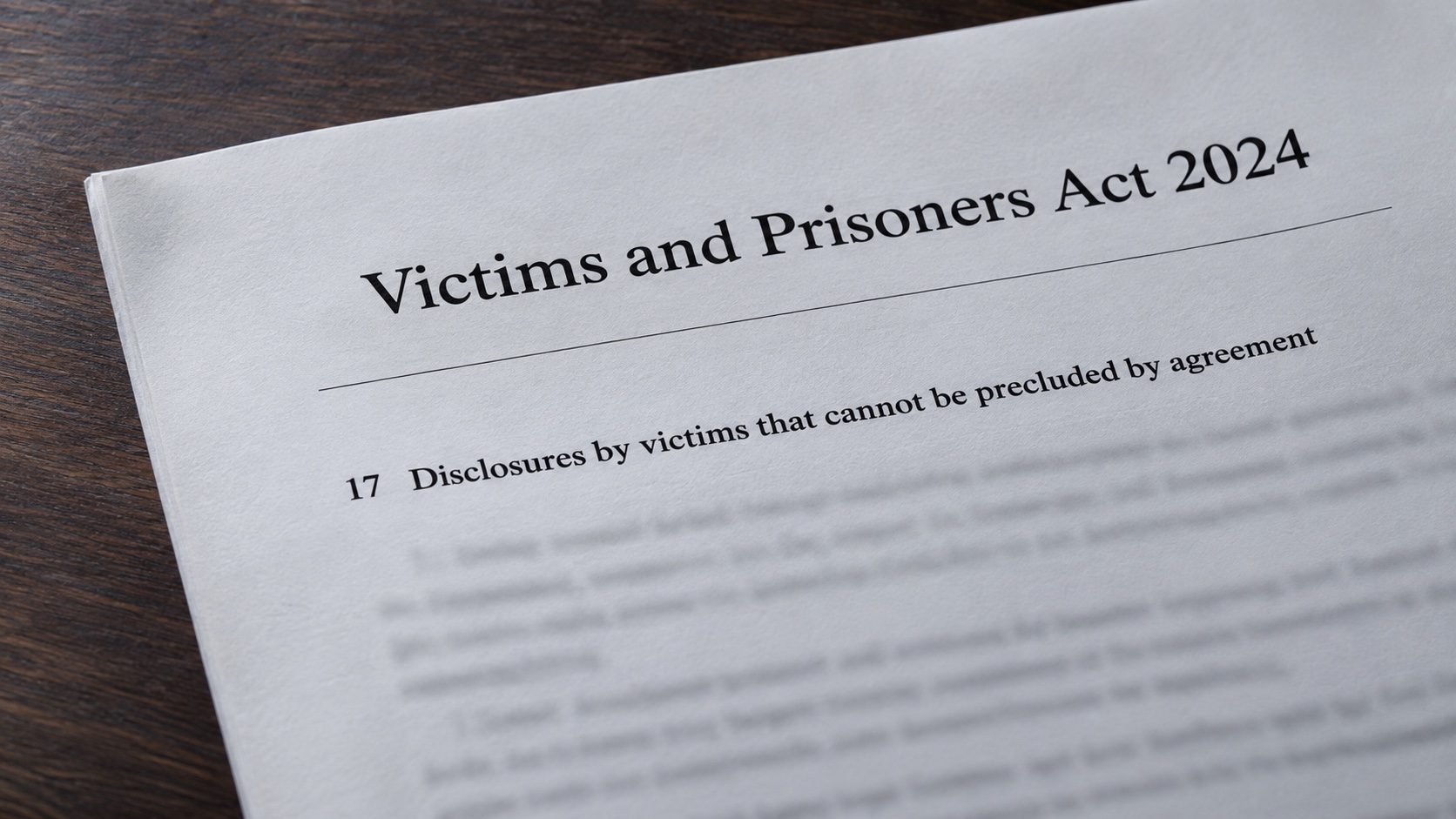
Section 77 of the Equality Act 2010 makes pay-secrecy terms unenforceable for relevant pay disclosures intended to establish whether pay differences relate to a protected characteristic. In England and Wales, section 17 of the Victims and Prisoners Act 2024 also voids confidentiality terms so far as they stop victims of crime, or people who reasonably believe they are victims, from making specified disclosures for specified purposes. The current list includes law enforcement, qualified lawyers, professional and victim-support services, and certain personal contacts. The legislation does not yet give unrestricted permission to publish the information to anyone.
How the law developed over the past 20 years
The starting point predates this period: the rule preventing an employer from contracting out of a worker's right to make a protected disclosure was introduced in the late 1990s and is now found in section 43J of the Employment Rights Act 1996. The changes below altered particular uses of confidentiality or the legal context in which NDAs are drafted. They did not make all NDAs unlawful.
2010: relevant pay disclosures
Section 77 of the Equality Act 2010 made a term of a person's work unenforceable so far as it prevents a relevant pay disclosure. This covers disclosure or requests for information made to establish whether pay differences are connected to a protected characteristic. It also protects certain requests to colleagues, including former colleagues. It is a targeted limit on pay secrecy, not a general right to publish every confidential employment term. The provision extends across Great Britain.
2013: the public-interest test for whistleblowing
The Enterprise and Regulatory Reform Act 2013 amended the Great Britain whistleblowing test so that a worker must reasonably believe that a qualifying disclosure is made in the public interest. This changed the conditions for a protected disclosure which section 43J prevents an employer from suppressing by agreement. It did not create a new general prohibition on confidentiality clauses.
2018: statutory trade-secret protections
The Trade Secrets (Enforcement, etc.) Regulations 2018 took effect on 9 June 2018 across the UK. They define a qualifying trade secret by reference to secrecy, commercial value arising from secrecy and reasonable steps to keep the information secret, and provide measures and remedies for unlawful acquisition, use or disclosure. They did not replace the law of confidence or remove legitimate commercial reasons to use an NDA.
2023–2024: a proactive duty to prevent sexual harassment
The Worker Protection (Amendment of Equality Act 2010) Act 2023 inserted section 40A into the Equality Act 2010. When it came into force on 26 October 2024, employers in Great Britain became subject to a proactive duty to take reasonable steps to prevent sexual harassment of employees in the course of employment. Where a tribunal finds sexual harassment and a breach of that duty, the Act provides for a possible compensation uplift of up to 25%. This was a workplace prevention duty, not a rule invalidating NDAs; the separate confidentiality reform was still to come.
2025: education and victims of crime
On 1 August 2025, section A1(11) of the Higher Education and Research Act 2017 took effect in England. It requires the governing body of a registered higher-education provider to secure that the provider does not enter an NDA with a staff member, member, student or visiting speaker about that person's relevant complaint of sexual abuse, sexual harassment, sexual misconduct, bullying or other harassment. If such an NDA is entered into, the provision makes it void. It is sector-specific: it does not apply to every employer or every education institution in England and Wales.
In England and Wales, section 17 of the Victims and Prisoners Act 2024 came into force on 1 October 2025 for agreements entered into from that date. It makes a term void so far as it prevents a victim of crime, or someone who reasonably believes they are a victim, from making specified disclosures for specified purposes. These include reporting to law enforcement, obtaining legal or professional advice, seeking victim support and speaking to certain close contacts. From 12 December 2025, additional compensation-related disclosures were protected, including to the Criminal Injuries Compensation Authority and in relevant proceedings. These protections are limited by the statute's conditions; they did not at that stage create an unrestricted right to disclose to the public or media.
2026: whistleblowing and stronger employer duties
From 6 April 2026, section 23 of the Employment Rights Act 2025 expressly added sexual harassment to the categories of wrongdoing capable of supporting a protected whistleblowing disclosure in Great Britain. The worker must still satisfy the other statutory requirements for protection; adding the category did not make every allegation a protected disclosure.
On 30 October 2026, the Great Britain duty to prevent sexual harassment strengthened from taking reasonable steps to taking all reasonable steps. A separate provision concerning harassment by third parties, such as customers or clients, also took effect. These changes address employer conduct. The broader rule voiding certain workplace harassment and discrimination NDA clauses had been enacted but was not yet in force at the article's as-at date; its planned commencement is discussed below.
Upcoming developments
Workplace harassment and discrimination. Section 24 of the Employment Rights Act 2025 provides for a new section 202A of the Employment Rights Act 1996. Once commenced, it will void a term in an agreement between an employer and worker so far as it prevents the worker alleging or disclosing relevant harassment or discrimination, or the employer's response. It can protect a witness as well as the person directly affected. The measure extends to Great Britain, including England and Wales. The Government's latest timetable places commencement in January 2027, subject to the necessary parliamentary steps. It is intended to apply to agreements made after commencement, not retrospectively. Regulations may set conditions for limited excepted agreements; the final details should be checked when published.
Victims of crime. Section 6 of the Victims and Courts Act 2026 would replace the present section 17 framework in England and Wales with a wider protection for allegations and disclosures about relevant criminal conduct and responses to them. The Government announced an intention to bring the change into force in January 2027, allowing victims to speak to a wider range of people, potentially including friends and the media. The exact commencement date, conditions for excepted agreements and any transitional effects must be checked in the implementing legislation. Until then, the narrower current section 17 rules remain the operative statutory scheme.
The Government has also said it will consider harassment-related NDAs outside the workplace during 2027. That is an announced policy direction, not an enacted general prohibition or a fixed commencement date.
Sources
- Employment Rights Act 1996, section 43J and Equality Act 2010, section 77
- Enterprise and Regulatory Reform Act 2013, section 17 and Trade Secrets (Enforcement, etc.) Regulations 2018
- Worker Protection (Amendment of Equality Act 2010) Act 2023 and Higher Education and Research Act 2017, section A1
- Victims and Prisoners Act 2024, section 17 and Permitted Disclosures Regulations 2025
- Employment Rights Act 2025: harassment and discrimination provisions
- Employment Rights Act 2025, section 24 and Government NDA factsheet
- Victims and Courts Act 2026, section 6 and Government announcement of 24 November 2026